Robot Arm Basics: Forward and Inverse Kinematics
Published:
Last updated:
Learning from: Solved Example - Forward Kinematics and Build Robot using Simple High School Math (YouTube)
These are my notes on the videos above, written the way I understand it. If you find a mistake, please email or message me.
This post follows my previous notes, Robot Arm Basics: Rotation and Translation. Here I use those two operations on a real example: forward kinematics (FK), and then turn it around to get inverse kinematics (IK).
Forward kinematics answers one question: given the joint angles and link lengths, where is something (the end effector, or an object it sees) as seen from the base?
1. Placing a frame on every joint
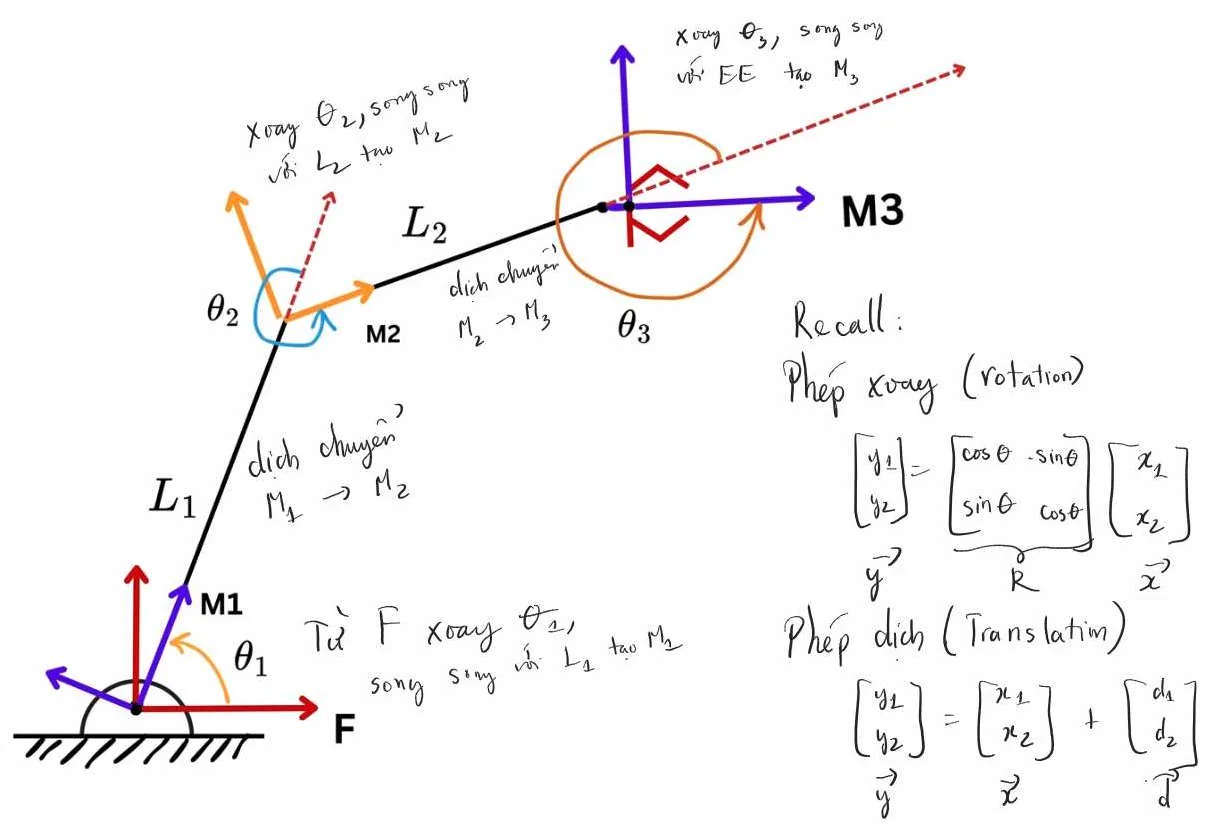
The arm has two links \(L_1\), \(L_2\) and three joint angles \(\theta_1, \theta_2, \theta_3\). We walk from the base to the tip and place one frame at each step:
- F → M1: start from the fixed frame F and rotate by \(\theta_1\), so that the x-axis of M1 points along \(L_1\). No translation yet (\(\vec{d}_1 = \vec{0}\)).
- M1 → M2: move along \(L_1\) to the second joint, then rotate by \(\theta_2\) so the x-axis points along \(L_2\).
- M2 → M3: move along \(L_2\) to the third joint, then rotate by \(\theta_3\) so the frame lines up with the end effector.
Because each new x-axis points along the next link, every translation is simply “move \(L\) along my own x-axis”:
\[\vec{d}_1 = \begin{bmatrix}0\\0\end{bmatrix}, \quad \vec{d}_2 = \begin{bmatrix}L_1\\0\end{bmatrix}, \quad \vec{d}_3 = \begin{bmatrix}L_2\\0\end{bmatrix}, \qquad R_i = \begin{bmatrix}\cos\theta_i & -\sin\theta_i \\ \sin\theta_i & \cos\theta_i\end{bmatrix}\]Note that \(\vec{d}_2\) is written in M1 and \(\vec{d}_3\) is written in M2, not in F.
2. The problem: where is the apple?
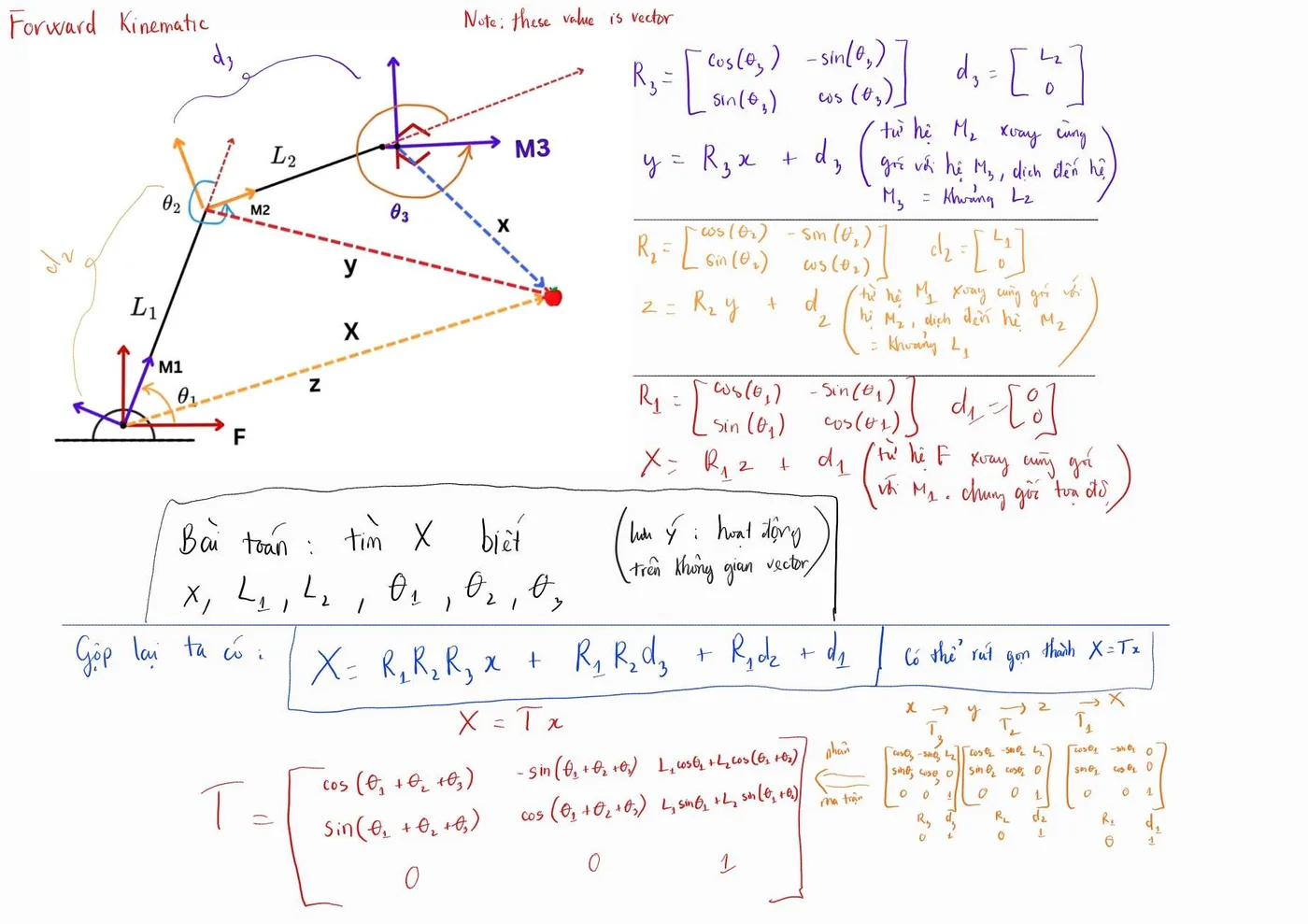
Given: \(\vec{x}\) (the apple’s position seen from the end effector frame M3), \(L_1, L_2\) and \(\theta_1, \theta_2, \theta_3\). Find: \(\vec{X}\), the apple’s position seen from the base frame F.
All of these are position vectors, not just distances: they have both a length and a direction.
We go back from the tip to the base, one frame at a time. Each step is “rotate, then translate” from the previous post:
| Step | Apple seen from | Formula |
|---|---|---|
| 1 | M2 | \(\vec{y} = R_3\vec{x} + \vec{d}_3\) |
| 2 | M1 | \(\vec{z} = R_2\vec{y} + \vec{d}_2\) |
| 3 | F | \(\vec{X} = R_1\vec{z} + \vec{d}_1\) |
Substituting step 1 into step 2, then into step 3:
\[\vec{X} = \underbrace{R_1R_2R_3\,\vec{x}}_{\text{rotation}} + \underbrace{R_1R_2\vec{d}_3 + R_1\vec{d}_2 + \vec{d}_1}_{\text{translation}}\]3. One matrix for each step
With homogeneous coordinates (add a 1 at the end of each vector), each step becomes one 3×3 matrix:
\[T_i = \begin{bmatrix}R_i & \vec{d}_i \\ 0\;\;0 & 1\end{bmatrix} \quad\Rightarrow\quad T_1 = \begin{bmatrix}c_1 & -s_1 & 0\\ s_1 & c_1 & 0\\ 0 & 0 & 1\end{bmatrix},\; T_2 = \begin{bmatrix}c_2 & -s_2 & L_1\\ s_2 & c_2 & 0\\ 0 & 0 & 1\end{bmatrix},\; T_3 = \begin{bmatrix}c_3 & -s_3 & L_2\\ s_3 & c_3 & 0\\ 0 & 0 & 1\end{bmatrix}\]Short notation to keep things readable: \(c_1 = \cos\theta_1\), \(s_{12} = \sin(\theta_1+\theta_2)\), \(c_{123} = \cos(\theta_1+\theta_2+\theta_3)\), and so on.
The chain \(\vec{x} \xrightarrow{T_3} \vec{y} \xrightarrow{T_2} \vec{z} \xrightarrow{T_1} \vec{X}\) gives
\[\vec{X} = T_1\,(T_2\,(T_3\,\vec{x})) = \underbrace{T_1T_2T_3}_{T}\,\vec{x}\]Order matters. \(T_3\) is applied first, so it sits closest to \(\vec{x}\) (on the right). The product is \(T_1T_2T_3\), not \(T_3T_2T_1\).
4. Computing T = T1 T2 T3
Writing the three matrices side by side, this is what we need to compute:
\[T = T_1T_2T_3 = \begin{bmatrix}c_1 & -s_1 & 0\\ s_1 & c_1 & 0\\ 0 & 0 & 1\end{bmatrix}\begin{bmatrix}c_2 & -s_2 & L_1\\ s_2 & c_2 & 0\\ 0 & 0 & 1\end{bmatrix}\begin{bmatrix}c_3 & -s_3 & L_2\\ s_3 & c_3 & 0\\ 0 & 0 & 1\end{bmatrix}\]We multiply from the right: first \(T_2T_3\), then \(T_1(T_2T_3)\). We also need these angle-sum formulas (from the previous post):
\[\cos(a+b) = \cos a\cos b - \sin a\sin b, \qquad \sin(a+b) = \sin a\cos b + \cos a\sin b\]Step 1: \(T_2T_3\) (row × column):
\[T_2T_3 = \begin{bmatrix}c_2c_3 - s_2s_3 & -c_2s_3 - s_2c_3 & c_2L_2 + L_1\\ s_2c_3 + c_2s_3 & -s_2s_3 + c_2c_3 & s_2L_2\\ 0 & 0 & 1\end{bmatrix} = \begin{bmatrix}c_{23} & -s_{23} & L_1 + L_2c_2\\ s_{23} & c_{23} & L_2s_2\\ 0 & 0 & 1\end{bmatrix}\]Step 2: \(T_1(T_2T_3)\):
\[T = T_1(T_2T_3) = \begin{bmatrix}c_1 & -s_1 & 0\\ s_1 & c_1 & 0\\ 0 & 0 & 1\end{bmatrix}\begin{bmatrix}c_{23} & -s_{23} & L_1 + L_2c_2\\ s_{23} & c_{23} & L_2s_2\\ 0 & 0 & 1\end{bmatrix}\] \[= \begin{bmatrix}c_1c_{23} - s_1s_{23} & -c_1s_{23} - s_1c_{23} & c_1(L_1 + L_2c_2) - s_1L_2s_2\\ s_1c_{23} + c_1s_{23} & -s_1s_{23} + c_1c_{23} & s_1(L_1 + L_2c_2) + c_1L_2s_2\\ 0 & 0 & 1\end{bmatrix}\]Simplify each entry with the angle-sum formulas:
- Top-left 2×2 block: \(c_1c_{23} - s_1s_{23} = c_{123}\) and \(s_1c_{23} + c_1s_{23} = s_{123}\).
- Last column, top: \(L_1c_1 + L_2(c_1c_2 - s_1s_2) = L_1c_1 + L_2c_{12}\).
- Last column, middle: \(L_1s_1 + L_2(s_1c_2 + c_1s_2) = L_1s_1 + L_2s_{12}\).
So the final result is
\[\boxed{T = \begin{bmatrix}\cos(\theta_1+\theta_2+\theta_3) & -\sin(\theta_1+\theta_2+\theta_3) & L_1\cos\theta_1 + L_2\cos(\theta_1+\theta_2)\\ \sin(\theta_1+\theta_2+\theta_3) & \cos(\theta_1+\theta_2+\theta_3) & L_1\sin\theta_1 + L_2\sin(\theta_1+\theta_2)\\ 0 & 0 & 1\end{bmatrix}}\]This matches the expanded formula in Section 2:
- Rotation part: \(R_1R_2R_3 = R(\theta_1+\theta_2+\theta_3)\). In 2D the angles just add up.
- Translation part: \(R_1\vec{d}_2 = L_1(\cos\theta_1, \sin\theta_1)\) and \(R_1R_2\vec{d}_3 = L_2(\cos(\theta_1+\theta_2), \sin(\theta_1+\theta_2))\). Each link is rotated by the sum of all angles before it. \(\theta_3\) does not appear because it only turns the end effector; it does not move it.
5. Inverse kinematics: the reverse problem
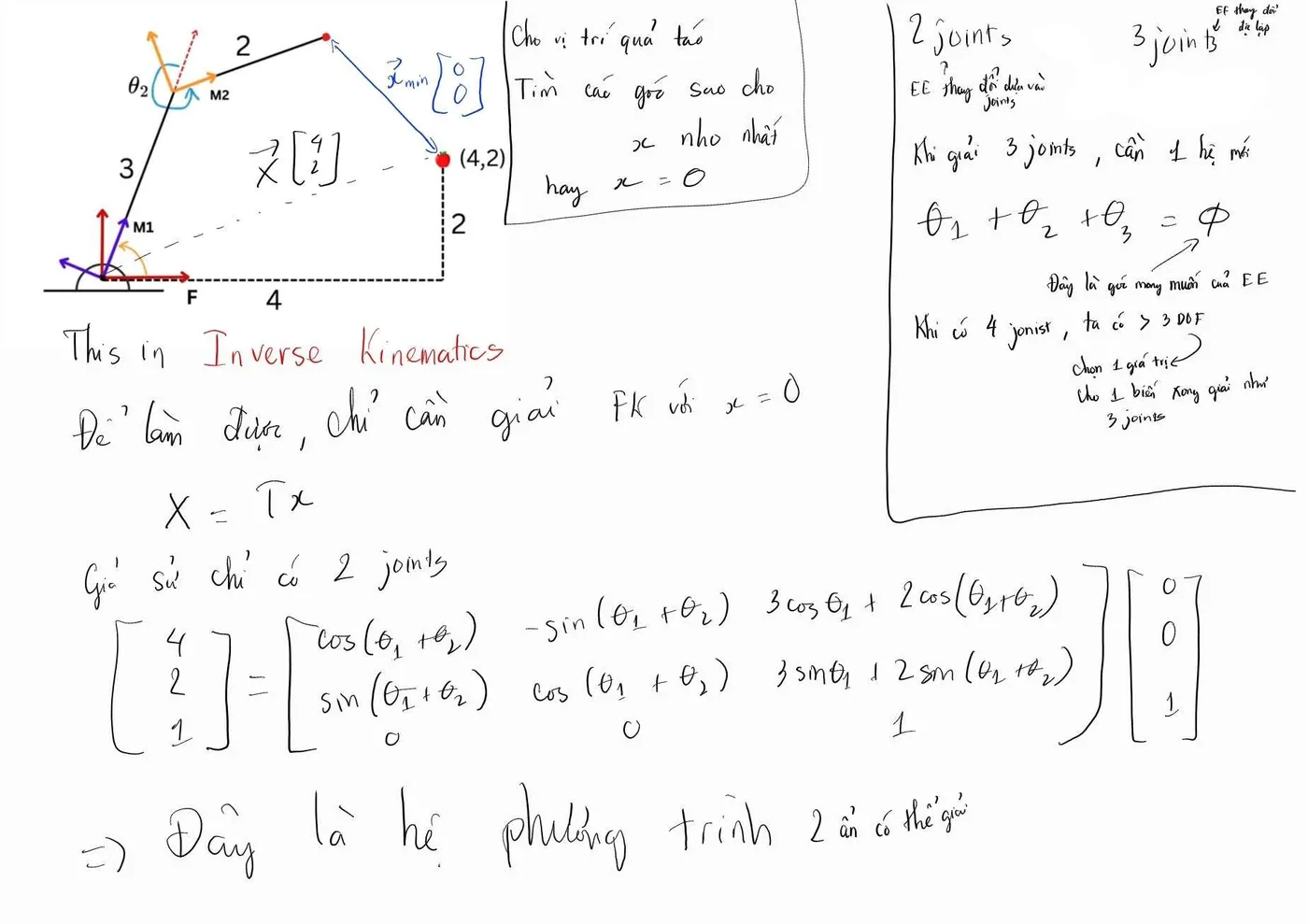
FK goes from angles to positions. Inverse kinematics (IK) goes the other way: we know where the end effector should go, and we look for the joint angles.
Usually we want the end effector to touch the apple, so the apple seen from the end effector is \(\vec{x} = (0, 0)\). With \(\vec{x} = (0, 0, 1)\), the product \(T\vec{x}\) keeps only the last column of \(T\). So IK is just the FK formula solved backwards with \(\vec{x} = 0\).
Example: 2 joints. \(L_1 = 3\), \(L_2 = 2\), and the apple is at \(\vec{X} = (4, 2)\):
\[\begin{bmatrix}4\\2\\1\end{bmatrix} = \begin{bmatrix}c_{12} & -s_{12} & 3c_1 + 2c_{12}\\ s_{12} & c_{12} & 3s_1 + 2s_{12}\\ 0 & 0 & 1\end{bmatrix}\begin{bmatrix}0\\0\\1\end{bmatrix} \quad\Rightarrow\quad \begin{cases}3\cos\theta_1 + 2\cos(\theta_1+\theta_2) = 4\\ 3\sin\theta_1 + 2\sin(\theta_1+\theta_2) = 2\end{cases}\]Two equations, two unknowns, so we can solve it:
- Find \(\theta_2\). Square both equations and add them. With \(\cos^2 + \sin^2 = 1\) and the \(\cos(a-b)\) formula, everything except \(\theta_2\) cancels: \(4^2 + 2^2 = 3^2 + 2^2 + 2\cdot3\cdot2\cos\theta_2 \;\Rightarrow\; \cos\theta_2 = \tfrac{7}{12} \;\Rightarrow\; \theta_2 \approx \pm 54.3^\circ\)
- Find \(\theta_1\). It is the angle to the apple minus the angle that link 2 adds: \(\theta_1 = \operatorname{atan2}(2, 4) - \operatorname{atan2}(2\sin\theta_2,\ 3 + 2\cos\theta_2)\) This gives \(\theta_1 \approx 47.9^\circ\) with \(\theta_2 \approx -54.3^\circ\) (“elbow up”, as in Fig 3), or \(\theta_1 \approx 5.3^\circ\) with \(\theta_2 \approx +54.3^\circ\) (“elbow down”).
Things to keep in mind:
- There are usually two solutions (elbow up and elbow down).
- There is no solution if the apple is out of reach: farther than \(L_1 + L_2\) or closer than \(\lvert L_1 - L_2\rvert\). Here \(\lVert\vec{X}\rVert = \sqrt{20} \approx 4.47 \le 5\), so it is reachable. If it is not, the best we can do is make \(\lVert\vec{x}\rVert\) as small as possible.
- With 2 joints we can only choose the position. The end effector’s angle, \(\theta_1 + \theta_2\), is whatever comes out.
3 joints. In 2D, a target has 3 numbers: position \((x, y)\) and the end effector’s angle \(\phi\). With a third joint we can choose \(\phi\) too, which adds a third equation:
\[\theta_1 + \theta_2 + \theta_3 = \phi\]Why the sum? Each \(\theta_i\) is measured from the previous frame, not from F. So each joint turns everything after it on top of the turns before it. We already saw this in Section 4: the rotation part of \(T\) is \(R_1R_2R_3 = R(\theta_1+\theta_2+\theta_3)\), and that rotation is exactly the orientation of the end effector frame M3 seen from F. For the end effector to point at angle \(\phi\), that total must equal \(\phi\).
In our arm, \(\theta_3\) only turns the end effector, so: solve \(\theta_1, \theta_2\) as above, then \(\theta_3 = \phi - \theta_1 - \theta_2\).
4 or more joints. Now the arm has more joints than the 3 numbers we need to control (it is redundant), so there are infinitely many solutions. A simple way out: fix the extra joint to any value you like, then solve as in the 3-joint case. In 3D, a target needs 6 numbers (3 for position, 3 for orientation). That is why arms like Piper have 6 joints, and Franka has 7 (one extra).
Summary
- Forward kinematics: from joint angles and link lengths, find positions in the base frame.
- Put a frame at each joint with its x-axis along the next link, so each \(\vec{d}_i = (L, 0)\) in its own frame.
- Go from the tip back to the base: \(\vec{X} = R_1R_2R_3\vec{x} + R_1R_2\vec{d}_3 + R_1\vec{d}_2 + \vec{d}_1\).
- In matrix form, \(\vec{X} = T_1T_2T_3\,\vec{x}\). The first transform applied (\(T_3\)) is on the right.
- For a planar arm, the rotation is \(R(\theta_1+\theta_2+\theta_3)\) and the position of the end effector is \((L_1\cos\theta_1 + L_2\cos(\theta_1+\theta_2),\ L_1\sin\theta_1 + L_2\sin(\theta_1+\theta_2))\).
- Inverse kinematics: from a target position, find the joint angles. Set \(\vec{x} = 0\) and solve the FK equations backwards.
- 2 joints control the position only. A 3rd joint also controls the end effector’s angle \(\phi\). Extra joints give infinitely many solutions, so fix the extras first.
Revision history
- : First published.